The hybrid organisation: how companies are splitting the work between people and AI
For two years the debate has been framed as people versus AI. This article looks at what the middle ground looks like in practice, and how to design it on purpose.
Between a fully human company and a fully autonomous one sits a middle ground, and that middle ground has a shape. This article lays out that shape: a spectrum with three working models in the hybrid zone, what a few well-known companies have said and done, and five design choices worth making deliberately in any hybrid organisation.
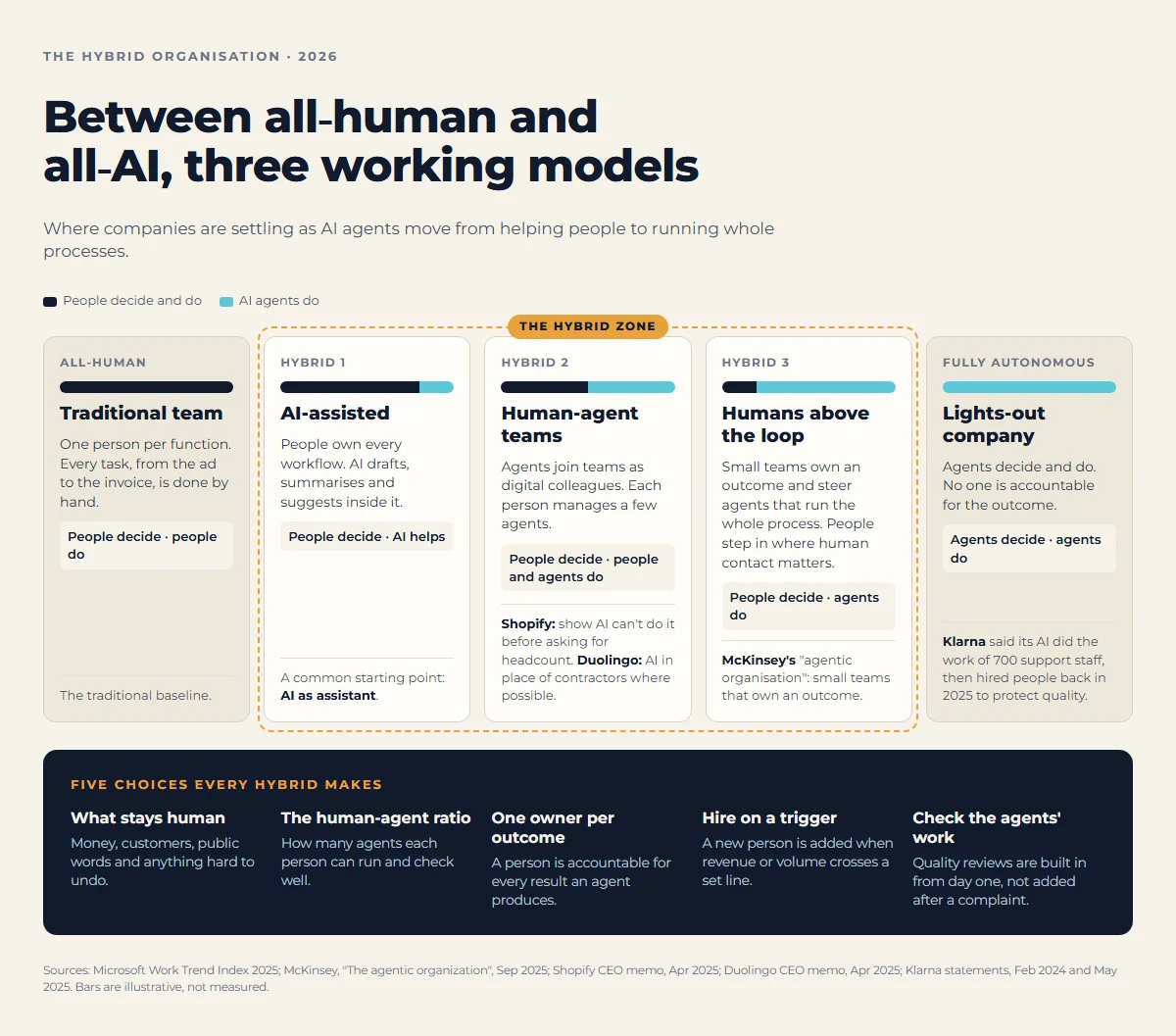
The spectrum: five models, three of them hybrid
- All-human: the traditional team. One person per function. Every task, from the ad to the invoice, is done by hand.
- Hybrid 1, AI-assisted. People own every workflow. AI drafts, summarises and suggests inside it.
- Hybrid 2, human-agent teams. Agents join teams as digital colleagues, and each person manages a few agents. People decide; people and agents do.
- Hybrid 3, humans above the loop. Small teams own an outcome and steer agents that run the whole process. People step in where human contact matters.
- Fully autonomous: the lights-out company. Agents decide and do, and no one is accountable for the outcome.
What other companies are doing
Shopify set the tone in April 2025. In a memo shared publicly, its CEO wrote that before asking for more headcount and resources, teams must demonstrate why they cannot get the work done using AI, and asked what each area would look like if autonomous AI agents were already part of the team (TechCrunch).
Duolingo followed the same month, announcing that it plans to use AI instead of new hires or contractors where possible (Tom's Guide).
Microsoft gave the idea a name. Its 2025 Work Trend Index describes the "Frontier Firm": an organisation built around intelligence on tap, human-agent teams and a new role for everyone, the "agent boss", who builds, delegates to and manages agents. It tells leaders they need a new metric, the human-agent ratio (Microsoft).
McKinsey describes a further step. Its "agentic organization" puts people above the loop, steering outcomes, and inside the loop only where human contact matters. Work is organised into small, flat teams that own an outcome from start to finish, with governance built into the system rather than bolted on (McKinsey).
The warning from the far end
Klarna is the case to study. In February 2024 it said its AI assistant could do the work of 700 customer service agents. By May 2025 its CEO was telling Bloomberg that AI was cheaper but produced lower quality, and the company was recruiting customer service staff again, so that a person is always available for a customer who wants one (Entrepreneur). The lesson is not to avoid AI. It is that the parts of a business where trust is made are the last place to remove people.
Five design choices for a hybrid organisation
A hybrid is a design choice, and it has to be made deliberately. Five choices are worth making deliberately when a human-AI team is set up:
- What stays human. Money, customers, public wording and anything that is hard to undo.
- The human-agent ratio. How many agents one person can direct and check properly.
- One owner per outcome. Every result an agent produces has a named person accountable for it.
- Hiring on a trigger. A new person joins when revenue or volume crosses a set line, not on instinct.
- Checking the work. Quality review of agent output is built in from the first day, not added after a complaint.
Put together, the choices settle who directs the agents, how many agents each person runs, and who owns each result. Judgement-heavy and high-stakes decisions stay with people.
Where to start
Pick one area, decide which of the five choices you are making for it, and write the answers down before any tool is bought. For brands that want a working team without full-time hires, see the Virtual Team. For repetitive work that can move onto automation, see AI & automation.
Tell us which work eats the most hours.
We will reply with what can be automated, what should stay with your team, and a quote.
Talk to us →- TechCrunch, 7 April 2025: Shopify CEO tells teams to consider using AI before growing headcount
- Tom's Guide: Duolingo wants to ditch contractors in favor of AI
- Microsoft, 23 April 2025: The 2025 Work Trend Index, the Frontier Firm is born
- McKinsey: The agentic organization, contours of the next paradigm for the AI era
- Entrepreneur: Klarna CEO reverses course, hiring more humans, not AI